Sourced fact
The News
The BRICS Group summit, scheduled for this weekend in New Delhi, is set to proceed under the shadow of President Donald Trump's policies, with echoes of division within the group regarding how to handle Washington resonating throughout. Leaders from 11 nations, including India as the host, China, Russia, Brazil, South Africa, the UAE, and Iran, will attend, while Saudi Arabia participates as an invited guest. Despite the group's significant economic importance—representing 49% of the world's population and 40% of global GDP—it is unlikely to issue a statement explicitly condemning the United States or establishing a unified strategy to resist Trump's policies.
Any criticism of Washington's policies in the final statement is expected to be vague and indirect, due to the sharp divergence in members' interests and the need to avoid confrontation with the White House, particularly given the UAE's presence; Iran has targeted the UAE, which hosts US bases. Furthermore, India, which is concluding final trade negotiations with the United States, will warn against any statement that might upset Washington, while China hesitates to use the group to target America, making a unanimous consensus extremely difficult to achieve.
Michael Kockelmanman, a senior fellow at the Atlantic Council, stated that the group's expansion has made it more important but increased the difficulty of reaching consensus, noting that India faces a major challenge in gathering countries with diverse views on the global system. He added that President Trump was keen to express his opposition to BRICS, particularly its efforts to reduce dependence on the US dollar, warning in November 2024 of imposing 100% tariffs if member countries resumed supporting an alternative currency.
The summit will also focus on strengthening financial cooperation and finding ways to facilitate cross-border payments using local currencies, a priority for Moscow and Tehran, which face severe US sanctions. It is also expected that the group will continue to defend the interests of developing nations and push for institutional reforms at organizations such as the UN, the IMF, and the World Bank, many of whom believe these bodies no longer accurately reflect the new global order.
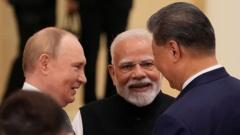
Leaders in New Delhi hope to leverage the summit to bolster India's position as a leader among developing nations, especially since its foreign policy priorities align with BRICS' broader agenda despite challenges posed by China's strong influence. The world will follow important bilateral meetings, including a meeting between Chinese President Xi Jinping and Indian Prime Minister Narendra Modi, who seeks to gradually rebuild relations, as well as a meeting with Putin to discuss the war in Ukraine.
Analysis & context
Analysis & Context
From an analytical perspective, the BRICS summit represents an opportunity for member states to strengthen their role as an alternative to Western alliances such as the G7 and the G20, particularly given their growing geopolitical and economic weight, which encompasses 49% of the world's population and 40% of global GDP. Although the group refrains from taking an overt stance against the West, it seeks to affirm its achievements through the New Development Bank, which has approved billions of dollars for infrastructure projects in Global South countries.
In the broader context, the summit focuses on facilitating cross-border payments in local currencies as a vital measure for countries facing US sanctions, such as Moscow and Tehran, reflecting the group's desire to reduce dependence on the US dollar, which Trump strongly warns against and threatens with 100% tariffs for any attempt to replace the greenback.
India's role at this summit is pivotal, as New Delhi seeks to affirm its status as a leader of the Global South while balancing China's significant influence with its own interests vis-à-vis the United States, especially after successfully hosting the G20 summit in 2023 despite deep disagreements over the war in Ukraine.
The summit will also witness important bilateral meetings, such as a meeting between Chinese President Xi Jinping and Indian Prime Minister Narendra Modi, who aims to cautiously repair relations between the two countries, as well as Modi's talks with Russian President Vladimir Putin, which will clearly address the file on the war in Ukraine.