Sourced fact
The News
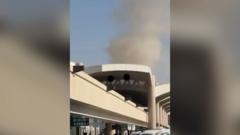
Recurrent attacks on King Khalid International Airport in Riyadh, Saudi Arabia, have resulted in the deaths of 12 people and injuries to 309 others. According to local authorities, the victims are from several nationalities, including four Saudis. The Saudi Civil Aviation Authority announced the suspension of operations at the airport following the attack, which is described as the deadliest incident in the kingdom since May 2015.
The Saudi-led military coalition, established in 2015 to counter the Houthis in Yemen, has declared the attack a "war crime" and blamed the Houthis for its occurrence. Colonel Turki Al-Maliki, the spokesman for the coalition, stated that the attack led to casualties among passengers and airport staff. He also pointed out that a shell landed near King Fahd International Airport in Dammam, eastern Saudi Arabia, resulting in an unspecified number of casualties.
UN Secretary-General Antonio Guterres condemned the attack, describing it as a "violation of international law that must stop immediately." Kuwait, Egypt, Bahrain, and Qatar also denounced the attack. Meanwhile, U.S. Senator Marco Rubio expressed deep concern over the attack, confirming that an American citizen was killed.
Following the attack, Western embassies in Saudi Arabia issued warnings to their citizens, advising them to avoid using airports in Riyadh, Jeddah, and Dammam until the situation becomes safe. Gulf airlines also canceled flights to these airports, affecting travel and the economy in the region.
These attacks come in the context of escalating tensions between government forces supported by Saudi Arabia and the Houthis, who control most of Yemen. The Houthis view their attacks on Saudi Arabia as a response to Saudi support for the Yemeni government and alleged restrictions on humanitarian and commercial supplies. These attacks challenge the unofficial ceasefire reached in 2022, which collapsed in July of this year.
Analysis & context
Analysis & Context
Analytically, this attack represents a dangerous development in the ongoing conflict between Saudi Arabia and the Houthis in Yemen. The increasing attacks on Saudi Arabia's civilian infrastructure reflect rising tensions and the failure of diplomatic efforts to end the fighting. In a broader context, the attack is linked to larger regional tensions, where the United States and Israel are seeking to ease tensions with Iran, increasing concerns about the ongoing conflict in Yemen. It is also worth noting that the Houthis see their attacks on Saudi Arabia as a response to Saudi support for the Yemeni government loyal to Saudi Arabia.