Sourced fact
The News
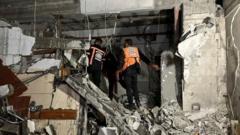
The Hamas-run Civil Defense Agency reported that an Israeli aerial strike targeted a building at Nasser Hospital in Khan Younis, southern Gaza Strip, killing at least six people and injuring twenty others. Mahmoud Basal, spokesperson for the agency, told AFP that the attack hit the hospital's surgery department and caused extensive damage, noting that one of the surgeons among the dead was killed in the strike that took place early Thursday.
No immediate response has been issued by the Israeli military to these claims so far, as BBC News continues its efforts to contact the Israeli army for an official comment on the incident details. However, BBC News faces restrictions imposed by Israel on independent work within the Gaza Strip, making independent verification of the attack's details impossible at present.
The Gaza Civil Defense, operating under the Interior Ministry of Hamas, is conducting rescue and recovery operations at the site with support from the International Committee of the Red Cross. Nasser Hospital is the largest hospital in southern Gaza and was previously hit by a double Israeli strike in August 2025, which killed at least 20 people, including journalists and health workers.
Israeli attacks on Gaza continue despite the ceasefire agreement reached last October; since then, the conflict has claimed more than 1,600 lives according to the Hamas-run Health Ministry, whose data is considered reliable by the United Nations. Israel and Hamas have also accused each other of violating the agreement terms, while the humanitarian crisis in the Strip has worsened due to recent heavy rains that flooded thousands of tents designated for displaced families.
Analysis & context
Analysis & Context
Analytically, this attack highlights the continued acute military tensions between Israel and Hamas despite official ceasefire agreements. Reports indicate that the truce has not fully halted military operations, reflecting the complexity of the political and military situation in the region and underscoring the difficulty of achieving lasting stability without a fundamental resolution to the crisis.
In the broader context, the deterioration of medical infrastructure in Gaza presents a major challenge for the international community and humanitarian relief efforts. Targeting hospitals and health facilities contradicts principles of international humanitarian law, intensifying criticism directed at the warring parties and raising concerns about the future of essential services for civilians.
Furthermore, harsh climatic conditions such as heavy rains that caused widespread flooding add another layer of complexity to the existing humanitarian crisis. This interplay between military and climatic factors creates an extremely difficult environment for recovery and threatens to increase the number of displaced persons and those in need of urgent assistance.
Finally, the continuation of fighting and violations of the ceasefire indicate that the strategic interests of both parties extend beyond the limits of any temporary peace agreement. This reality calls for precise international monitoring and serious dialogue to reactivate ceasefire mechanisms and protect civilians from further loss of life and property.