Sourced fact
The News
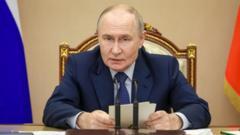
The PC News newspaper anticipated that the Russian election results would be in a completely predictable race, where the pro-President Vladimir Putin United Russia party retained its constitutional majority in the State Duma with numbers greater than the previous round, while no other party managed to approach it.
Despite the war on Ukraine continuing for more than four and a half years, causing huge military losses, economic difficulties, and widespread fuel shortages, the Russian political system remained under strict Kremlin control without any election surprises or shocks.
The only previously allowed party to participate in elections, Yabloko, was excluded from the parliamentary list just twelve days after its registration, according to the Supreme Court, which considered it a threat due to its peace message that gained popular momentum.
Nikolai Ryabkov, head of the Yabloko party, clarified that the result was expected because all ten participating parties support Putin's policies, noting that the new State Duma will vote 100% in favor of these policies exactly as the previous council did.
Regarding individual elections, the party reported that about a hundred candidates remained competing in constituencies but none won a parliamentary seat amidst continuous pressures including the imprisonment of some candidates and preventing others from running.
Ukraine also launched a massive drone attack on the Moscow region before the end of elections, resulting in three deaths in the area and damaging an oil refinery in the capital, while voters showed a calm sense of denial towards these attacks that have become part of their daily lives.
The newspaper noted that the Kremlin will use election results as a "popular mandate" to justify continuing the war and adopting future decisions, despite Putin denying a new mobilization scenario saying there is no need for it today.
Analysis & context
Analysis & Context
From an analytical perspective, the results indicate that the Kremlin will use these elections as evidence of the people's unity behind the president to justify continuing his current policies and the course of the war. Although Putin officially denied any scenario requiring new army mobilization, Russian society still suffers from deep anxiety about the possibility of calling up new soldiers in the near future.
In a broader context, these elections reflect the nature of the Russian political system actually controlled by a single party despite the existence of other small parties. The absence of any real change in the composition of the Duma confirms that parliament will not make decisions contradicting Kremlin interests or war policies.
Moreover, the ongoing attacks on Russian territory, such as the recent attack on the Moscow region, show how the capital has become an actual front line, changing the nature of daily life for Russian citizens and affecting their psychological and social stability.
Finally, the continuation of the war for more than four years has led to huge human and material losses in the Russian army and severe economic difficulties, including fuel shortages resulting from Ukrainian drone strikes on Russian oil facilities.