Sourced fact
Today's top politics stories
The global political arena witnessed significant developments today, including Democrats securing a majority in the U.S. Congress, climate warnings issued by Northern European nations, and socio-economic disruptions in Belgium and the European Union. These events reflect a clear divergence between internal government challenges and international efforts to reshape economic and security relations amidst changing circumstances.
Democrats Win Largest House Majority Since 1992 After North Carolina Flip
Democratic parties achieved a landslide victory in the U.S. House of Representatives for the first time since 1992, with Democrat Chuck Hubbard defeating Republican Virginia Fox in North Carolina's district, according to a BBC News report. This win followed Sunday's election result announcement, where Fox lost by a margin of 330 votes after 99% of ballots were counted, marking one of the closest races in recent midterm elections that also saw Democrats gain control of the Senate.
Iceland's Former PM Warns Climate Change Remains an Existential Threat as Global Power Politics Sidelines Action
Katrín Jakobsdóttir, former Prime Minister of Iceland, warned that climate change remains an existential crisis despite its declining priority on the international political agenda, as reported by Al Jazeera. She emphasized in her statements that a warming world is not merely an environmental disaster but a health and security emergency that cannot be ignored amid the policies of major powers. She noted that Iceland sits on the front line of this emergency, with the Arctic region experiencing temperature rises four times faster than the global average.
Belgian Strikes Disrupt Flights and Trains Over Austerity Plans
Hundreds of flights were grounded and train services severely disrupted across Belgium due to a general strike opposing proposed government austerity plans, according to BBC News. All flight operations ceased at Zaventem Airport in Brussels capital, as well as Charleroi Airport, which hosts low-cost carriers such as Ryanair. This strike occurred after Prime Minister Bart De Wever failed to reach an agreement on a cost-cutting budget with coalition partners, while King Philippe rejected his resignation, granting De Wever additional time for negotiations.
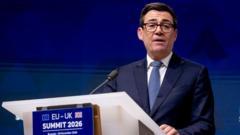
UK Prime Minister Announces Historic EU Deal to Boost Next Decade
British Prime Minister Rishi Sunak will announce in parliament a historic agreement with the European Union promising to open auspicious prospects for improving economic and social conditions over the next decade, according to Al Jazeera. The accord covers areas including British food exports, emissions trading, and youth internship programs, with the Prime Minister viewing it as a critical choice between maintaining a struggling status quo or driving transformative change. It also includes a new youth internship program set to launch by January 2030, allowing over 100,000 young people and scholars from the EU aged 18 to 31 to travel, work, and study in the United Kingdom for up to three years.
Analysis & context
Reading the day's news
Analytically, these stories connect national sovereignty with shared global challenges, where the U.S. Democratic victory serves as a tool to review President Donald Trump's policies amid the Iran war and rising inflation, while Iceland's former Prime Minister highlights how climate issues are marginalized in favor of geopolitical conflicts among major powers. In the broader context, Belgium's strike reveals the fragility of democratic systems facing social movement demands that challenge government austerity policies, reflecting a struggle between economic necessity and union rights. Regarding international relations, Britain's announcement of its EU agreement represents an attempt to restore economic stability after a period of isolation, while forces such as Reform UK and British opposition face challenges in accepting closer ties or even rejoining the bloc. Overall, these events collectively indicate that governments seek a delicate balance between domestic economic interests and international commitments, with external factors like wars and climate crises continuing to influence local policy choices.