Sourced fact
The News
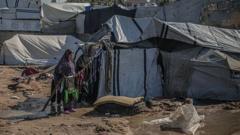
The "Peace Council" affiliated with former US President Donald Trump has called on Israel to immediately allow the entry of all necessary humanitarian supplies into the Gaza Strip after floods submerged tens of thousands of tents. While acknowledging the steps Israel is currently considering, the Council clarified that the response remains insufficient according to BBC News.
In a related development, the Israeli military agency responsible for coordinating aid stated it has permitted the entry of tens of thousands of tents and winter supply trucks, but added that reconstruction cannot begin until Hamas's arsenal is fully dismantled, as per the original text. A sand bunker collapse on tents in central Gaza on Sunday killed three children and one woman, according to BBC News.
The report indicates that most of Gaza's population has been displaced due to Israeli military operations, with approximately 1.4 million people—or about 65% of the population—currently living in tents and temporary shelters, per UN estimates. Mohammed Janaid, standing soaked in Gaza City for AFP, stated that heavy rains struck from one side while sewage water filled the area from the other, making the ground and tents unable to withstand the pressure.
In a rare instance of criticism directed at Israel, the Peace Council urged the Israeli government to authorize the entry of essential goods for temporary shelters and water and sewage infrastructure. The Council added that delays in approving supplies have exacerbated the expected humanitarian crisis and hindered the start of dismantling weapons and transferring authority from Hamas to a transitional government.
Analysis & context
Analysis & Context
From an analytical perspective, this situation highlights the sharp contradiction between the urgent need for humanitarian relief in Gaza and Israeli military restrictions that prevent the entry of essential survival equipment. These tensions reveal the difficulty in implementing the ceasefire agreement reached in October 2025, which requires Hamas to surrender its weapons in exchange for a gradual Israeli withdrawal from 60% of the sector it still occupies.
In the broader context, this scene represents a continuation of the conflict ongoing since Hamas's attacks on Israel on October 7, 2023, which resulted in approximately 1,200 deaths and the hostage-taking of 251 others. According to the Hamas-run Ministry of Health, the Israeli military killed an estimated 74,645 people during its campaign, while the UN confirms the reliability of these figures.
The debate over responsibility for humanitarian disasters appears to be deepening with mutual accusations between Israel and Hamas; Israel accuses Hamas of hoarding aid and hindering progress, while Hamas claims that Israeli restrictions are the primary cause of civilian suffering. BBC News notes that this dispute has stalled subsequent phases of the peace plan, with each side blaming the other for delays.
The coordination between the Peace Council and international organizations such as the United Nations Office for the Coordination of Humanitarian Affairs (OCHA) indicates an international effort to salvage the humanitarian situation, but Israeli restrictions and funding shortages limit the effectiveness of these efforts. Basic supply stocks within Gaza have reportedly been exhausted, according to UN humanitarian coordinator Ramiz Al-Khrouf on Monday.