Sourced fact
The News
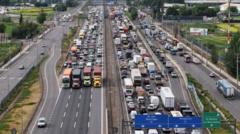
Hundreds of bus and lorry drivers are blocking traffic along major highway routes across the country. Hundreds of transport workers in Chile have announced the closure of roads and main highways nationwide in protest against the massive rise in fuel prices. Bus and truck drivers began their strike on Tuesday, gathering in large convoys to disrupt traffic on key routes throughout the state.
The workers are demanding that the government ease the burden of rising diesel prices, which have increased significantly due to the ongoing war in Iran, according to BBC News. Talks between government officials and protest leaders have so far failed to reach a compromise, with expectations of a new meeting on Wednesday to try to break the deadlock.
This strike is being carried out in coordination by the "Fuerza del Norte" trade union, which represents about 80% of truck drivers in Chile, as well as the civil protest movement "Noblejas". Andrés Alalcoñ, spokesperson for the civil movement, said after the collapse of talks on Tuesday that "there is no point in agreeing with a government that cannot offer any perspective to solve problems for everyone," reaffirming the continuation of the strike.
Economy Minister Daniel Mass called for continued dialogue but warned at the same time that "at some point we will have to open the roads." The minister emphasized that protests negatively affect economic activity and exports, considering that the country urgently needs to restore economic momentum. The government of President José Antonio Kast has faced continuous public criticism regarding fuel prices for months.
Joaquín Cornegio, president of the Association of Intercity Bus Owners representing 14 medium-sized companies, stated that they have "reached our limit" after spending more than a month working with negative figures. Claudio Eguizabal, a truck driver who participated in a protest near the capital Santiago on Tuesday morning, also confirmed that the situation is currently unsustainable, as it generates no profit and sometimes forces him to invest his own money to cover customer costs.
Analysis & context
Analysis & Context
From an analytical perspective, this strike demonstrates how regional geopolitical crises such as the war in Iran can directly reflect on the local economies of neighboring countries through global energy prices. The sharp rise in diesel cost is not merely a transient exchange rate fluctuation but an indicator of the fragility of global supply chains and the impact of distant conflicts on nearby local markets.
In the broader context, Chile faces structural economic challenges that make it very sensitive to fuel price fluctuations, especially with the transportation and logistics sectors heavily dependent on fossil energy. This dependence makes any external shock such as the war in Iran a direct threat to domestic price stability and companies' ability to operate efficiently.
Furthermore, the nature of protests combining large trade unions and independent civil movements reflects increasing social tension in Chile, where traditional dialogue between the government and the private or civil sector fails to address street demands quickly enough. This failure in negotiation creates an environment of polarization that could lead to further escalation if closures continue without practical compromises.
Finally, Economy Minister's statements about the necessity to "open the roads" at some point highlight the constant tension between the need for trade movement stability and continuous public pressure on the government to respond to citizens' demands for affordable fuel prices.