Sourced fact
The News
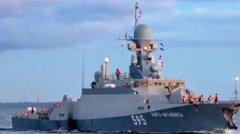
Finnish authorities confirmed that a Russian warship was attacked in the Gulf of Finland on Wednesday, marking the first known strike on a Russian vessel in the open waters of the Baltic Sea accessible to civilian maritime traffic. Ukraine's Security Service (SBU) attributed the attack to drones targeting the "Naro-Fominsk" ship as part of a broader operation against Russia's oil export hub at Oiltailuga on the Baltic coast.
The Finnish Ministry of Foreign Affairs stated that the incident was a direct result of the ongoing full-scale Russian war, while defense officials urged caution regarding Ukraine's actions, noting that the gulf is a narrow channel used by oil tankers and civilian ships and contains undersea data cables. Estonia's Defense Minister Martin Herveim reported that the "Boyah-M" class ship was hit around 5:30 AM on Wednesday, emitted smoke, and then returned toward St. Petersburg without details provided regarding the extent of damage or casualties.
Hervé Timkhov, spokesperson for Ukraine's Ministry of Foreign Affairs, described Moscow's claims that Ukraine used Baltic states' airspace as "lies," while acknowledging that incidents could occur when Russia attempts to redirect drones through electronic warfare. Hervé also noted that NATO alliance military aircraft were in the air during the attack but deemed it unsafe to destroy the drones, fearing unintended escalation in a sensitive area. Finnish officials confirmed that airspace remained stable and maritime navigation was safe.
Although theoretically an exception, this attack was not considered a dangerous escalation by military analyst Emil Kasteheimi, who pointed out that Ukraine had exploited a narrow window of opportunity. Ships targeting incidents have repeated in the Black Sea since Russia's invasion began in February 2022, while the Oiltailuga strike involved multiple storage tanks engulfed in flames and observed from the Estonian border.
Analysis & context
Analysis & Context
From an analytical perspective, this attack represents a shift in the nature of military operations in the Baltic Sea, where the region was previously considered more calm compared to the Black Sea, which has witnessed repeated ship strikes since February 2022.
In a broader context, the role of NATO alliances and the presence of its aircraft in Baltic states emerges as a complex factor. Hervé noted that planes were not considered safe for destroying drones due to fears of unintended escalation in a sensitive area.
Military expert Emil Kasteheimi indicated that the Russian navy in the Baltic Sea remained unprecedented until now, while Ukraine exploited a limited window of opportunity to attempt expanding its strike scope beyond traditional borders.
The report also highlights diplomatic tensions surrounding the use of regional airspace. Hervé Timkhov denied that Ukraine used Baltic states' airspace for attacks, dismissing Moscow's claims as unrealistic and lacking factual basis.