Sourced fact
The News
President Donald Trump announced today an immediate ban on three major American news outlets—CNN, MS NOW (formerly MSNBC), and Politico—from entering the White House compound. Media professionals have condemned this move as an illegal attack on press freedom.
The announcement came via a post on Trump's Truth Social platform on Friday, in which he claimed these channels "consistently write or report about lies and fables" regarding his administration without providing any specific examples to support his allegations.
In an urgent statement, CNN declared that the proposed ban constitutes an illegal infringement on journalists' constitutional rights, reaffirming its commitment to supporting its team at the White House in reporting fairly and accurately without government interference. The network emphasized that the U.S. Constitution guarantees the right to perform this journalistic role without intervention, stating that enforcing the ban would be a clear violation of constitutionally protected rights.
Politico also issued a statement affirming its continued commitment to covering the White House fairly and defending First Amendment rights against any attempt to restrict them. While MS NOW declined to comment on the matter immediately, journalists from CNN and Politico remained present at the White House compound directly after the announcement. Meanwhile, one of Trump's camera crews accompanied Vice President JD Vance during his travels to an event in Iowa.
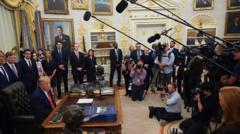
Later, speaking from the Oval Office, President Trump stated that the ban resulted from a buildup of negative stories over the years that left him angry, anticipating legal challenges that could lead to the decision being struck down by the courts. He added, "There is no reason to announce this in the afternoon," suggesting other channels might join the list but noting he had not named any specifically yet.
This announcement comes amid escalating tensions between the president and White House media figures since his return to power in January 2025. Previous actions include taking control of the press pool managed by the White House Correspondents' Association for a century and restricting access for Associated Press reporters due to their use of the term "Gulf of Mexico" instead of "Gulf of America."
Jacqui Heinrich, head of the White House Correspondents' Association, stated that the issue concerns the American public's right to receive independent information about the activities of the nation's highest office. The Knight First Amendment Institute at Columbia University criticized the move as a blatant double violation of the First Amendment, noting that the press pool is considered a "public forum" under the First Amendment and cannot exclude journalists based on their viewpoints.
Bruce Brown, chairman of the Committee to Protect Journalists, called the ban clear viewpoint discrimination and predicted it would be quickly overturned by courts for violating the Constitution clearly. The Free Press organization also found the step illegal and difficult to understand, arguing that Trump's ongoing retaliation against media has never benefited him but instead reveals his fear of an informed public.
Analysis & context
Analysis & Context
From an analytical perspective, this ban represents a dangerous escalation in the ongoing conflict between President Trump and American media since his return to power in January 2025. This move follows other decisions, such as taking control of the "press pool" operated by the White House Correspondents' Association for a century, and banning Associated Press journalists due to their use of the term "Gulf of Mexico" instead of "Gulf of America."
In the broader context, Trump's administration faces sharp criticism from legal and human rights organizations asserting that excluding journalists based on their opinions or reports contradicts the First Amendment of the U.S. Constitution. Legal experts argue that the press pool is considered a "public forum" where the government has no right to exclude specific entities, making any potential ban clearly unconstitutional.
The administration also seeks to alter the dynamics of the press room by introducing conservative bloggers and influencers, viewing this as necessary for providing diverse perspectives. However, this step raises concerns about transforming news coverage into a biased propaganda platform. Trump has previously filed lawsuits against several major media institutions, including The Wall Street Journal, The New York Times, and the BBC.
The CNN case is one of the most sensitive issues, as the network was the only one among five American channels to capture video of the press pool. Its reporter Jim Acosta's credentials were previously restored after a successful lawsuit. Analyses suggest that any court ruling against Trump in this case could set a strong legal precedent limiting his future powers in dealing with the media.