Sourced fact
The News
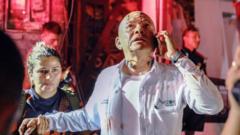
A devastating car bomb exploded in the center of Villavicencio, located in the heart of Colombia on Monday, resulting in injuries to at least 23 people and the destruction of several buildings in front of the regional government headquarters. No group has claimed responsibility for this attack, which marks the latest in a series of assaults targeting official buildings and security force headquarters using explosives.
Colombian President Gustavo Petro attributed these acts to "drug-supported terrorism," affirming that his government will respond forcefully to every drop of Colombian blood spilled with no tolerance or retreat. This escalation comes as armed attacks have increased as part of revenge campaigns by armed criminal groups against strikes ordered by the president against these factions.
The explosion occurred the night before the 10th anniversary of the signing of the peace agreement between the government and the Revolutionary Armed Forces of Colombia (FARC), the country's largest left-wing gang. Although thousands of rebels laid down their arms after the signing, a large number of FARC members who rejected the agreement joined other rebel groups, and attacks continued under the leadership of these new groups and criminal gangs controlling the drug trade and illegal mining.
Analysis & context
Analysis & Context
From an analytical perspective, this explosion represents a critical turning point in the trajectory of the "Comprehensive Peace" that former President Juan Manuel Santos attempted to implement through negotiations with armed groups. Talks with many of these groups, which violated the agreed ceasefire, failed, leading to the collapse of the peace strategy and a resurgence of increasing violence.
In the broader context, new President Gustavo Petro condemns the 2016 agreement as a "false peace" and insists that current violence stems from implementation failures rather than the agreement itself. Opponents of this view, such as former President Juan Manuel Santos, argue that accusations against the agreement are incorrect and that the real problem lies in the state's insufficient execution of its terms.
Reports indicate that armed criminal groups fighting to control the drug trade and extortion have increased their attacks as part of a counter-strategy against government pressure. This shift from traditional armed conflict to drug-supported guerrilla warfare complicates peacebuilding efforts and threatens the stability of the entire nation.
The new president's stance explicitly rejects the heirs of the 2016 agreement, which he describes as "chaos" and a waste of public resources, sparking widespread debate among security and political experts in Colombia. While Santos defends the agreement and insists that current violence is a result of non-implementation rather than the agreement itself, the reality on the ground shows an escalation in attacks targeting civilians and security forces. The explosion is the latest in a string of attacks on buildings housing the security forces and government offices.