Sourced fact
The News
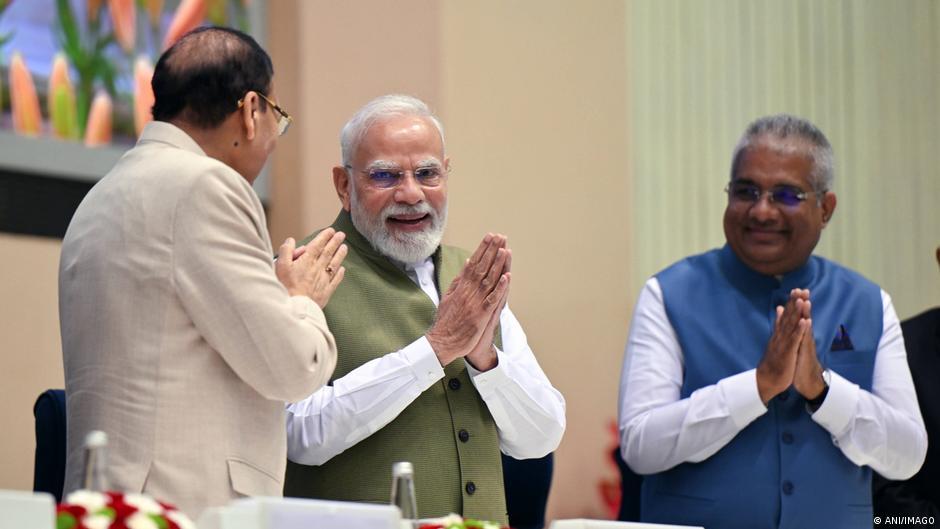
Indian Prime Minister Narendra Modi declared at an international conference in New Delhi that developing nations are unfairly held responsible for carbon emissions compared to advanced nations. Modi stated that India's per capita emission contribution is less than half the global average, while per capita emissions in developed countries reach six times what they are in India.
In sports, Indian cricketer Smriti Mandhana became the record holder for the most runs scored in T20 World Cup history for women after scoring 37 runs during the match where India defeated Bangladesh by 114 runs. Her teammate Shafali Verma also achieved a historic milestone by recording her maiden century at the Women's Asian Games, making her the third Indian woman to accomplish this feat after Mandhana and captain Harmanpreet Kaur.
In a prominent social case, the Allahabad High Court ordered police to protect a couple consisting of a Hindu woman and a Muslim man living together in an informal relationship who faced threats from both families. The court rejected the Indian government's claims that same-sex relationships undermine traditional societal frameworks, affirming that living together is a fundamental right for consenting adults without coercion or fear.
At the Indian Institute of Technology Bombay (IIT Bombay), the university faced severe criticism following the death of a 20-year-old student due to alleged caste-based mistreatment by one of the professors. Police filed a case against Professor Srinivasa D and other unidentified individuals under laws related to instigating suicide and preventing harm to scheduled castes, while the university denied having taken disciplinary action against him prior to his death.
Additionally, the Asian Games organizing committee replaced the traditional flag bearer at the opening ceremony due to a lack of ceremonial equipment for the role. In Mumbai, community food-foraging activities helped residents connect with nature and yielded unexpected environmental benefits for the Gujarati community in the city.
Analysis & context
Analysis & Context
Analytically, these statements spark significant debate among politicians and scholars regarding the concept of "historical responsibility" versus "current capacity." The discussion revolves around the right of poorer nations to economic growth versus the urgent need to curb pollution to protect the planet.
In a broader context, this stance represents part of the ongoing tension between the Global North (developed countries) and the Global South (developing countries) over international climate agreements. India, one of the largest contributors to total emissions despite remaining a developing nation, becomes a target for international criticism.
Historically, the 2015 Paris Climate Agreement represented a turning point attempting to reconcile these conflicting interests, but practical implementation remains highly contentious. Modi's statements demonstrate India's continued defense of its economic interests while maintaining certain environmental commitments.
Finally, such declarations may reshape global climate alliances, as developing nations seek financial and technical support from wealthy countries to reduce emissions without harming their rapid economic growth.