Sourced fact
The News
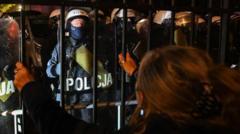
Riot police units have been ordered to deploy outside the premises of the Constitutional Tribunal in Warsaw, Poland, to secure the building and prevent any protesters from entering. This security intervention comes amid a sharp escalation in the dispute between Prime Minister Donald Tusk's government, which aims to depoliticize the judiciary, and the former leaders of the court who belong to the right-wing "Law and Justice" party.
The deployment of police followed a request by Justice Minister Waldemar Zurek to revoke the judicial immunity of President Bogdan Schwedowski and his deputy Bartłomiej Suszko in order to bring criminal charges against them. In a firm response, the Constitutional Tribunal stated via a social media post that these two judges still hold their highest legal offices, and any attempt to prosecute or oust them is considered a crime of state coup.
Prime Minister Donald Tusk also declared that restoring the rule of law is a national duty, describing the process as difficult and sometimes painful, requiring decisive and unavoidable measures. Conversely, Polish President Karol Nawrocki, who belongs to the "Law and Justice" alliance, cut short his trip to Senegal and ordered his aircraft to return to Warsaw, while the Constitutional Tribunal refused to recognize the validity of some newly elected judges.
The escalation came after the government suspended two senior justices and moved to bring criminal charges against them.
Analysis & context
Analysis & Context
From an analytical perspective, this scene represents the climax of a long-standing constitutional crisis that began in 2015 when the "Law and Justice" party assumed power, appointing judges unlawfully to secure a majority on the Constitutional Tribunal, which has the authority to annul laws. This move led to rulings by European courts stating that the Polish tribunal is no longer an independent and impartial judicial body, prompting the current government to officially stop publishing its judgments.
In a broader context, Justice Minister Zurek's statements indicate a radical shift in the new government's strategy, which rejects recognition of the previous dominance over the judiciary and aspires to completely restructure the judicial system. However, Tusk faces significant challenges from President Nawrocki, who uses his veto power to block new appointment attempts; furthermore, his decision to refuse taking the oath for some newly elected judges complicates the legal landscape and sparks debate over the legitimacy of the measures taken.
Suspending the current president of the tribunal and his deputy represents a dangerous turning point that may undermine the prestige of the Polish judiciary in the long term, according to critics of this step such as lawyer Marcin Macha, who warned that such actions will bury the cause of the rule of law for decades to come. Additionally, the upcoming election cycle adds a political dimension to the dispute, as the government seeks to bolster its popularity among voters by portraying itself as a guardian of the rule of law against past corruption.