Sourced fact
The News
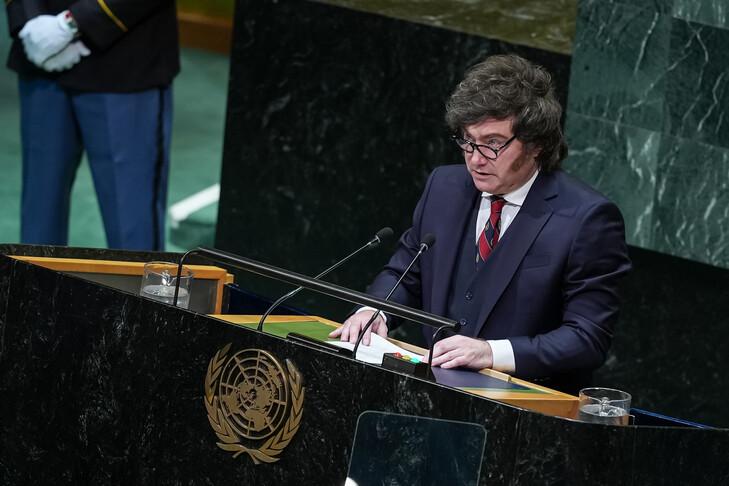
Argentine President Javier Milei has accused the United Nations of failing to intervene in the sovereign dispute over the Falkland Islands, South Georgia and the Sandwich Islands, stating that unilateral actions continue despite international calls for a negotiated solution. During his address at the UN General Assembly, Milei emphasized that these islands represent a national issue for Argentina, describing the conflict as highlighting the gap between international institutions and the reality they seek to address.
President Milei rejected the UN's position by referencing General Assembly Resolution 31/49, adopted in 1976, which urges both nations to accelerate negotiations on sovereignty and avoid any unilateral decisions that could alter the status quo before the dispute is resolved. Milei stressed that nearly half a century has passed since this resolution without resolving the matter, noting that unilateral actions persist despite international reservations.
He also underscored the "Celia" oil project, which includes plans to exploit hydrocarbon resources in the northern Falkland Basin. He considers the project involves extracting oil from Argentina's continental shelf through British licenses, which Buenos Aires rejects as illegal and illegitimate. The roots of the dispute date back to 1833, when the islands came under British administration, while Argentina maintains its sovereign claim over the islands and surrounding maritime areas.
This conflict led to a 74-day war between Argentina and Britain in 1982 after Argentine forces occupied the islands, with Britain regaining control after the end of the conflict. Milei's statements come amid renewed tensions over oil exploration around the islands, as Argentina continues to reject any hydrocarbon activities funded by the British in waters it considers part of its sovereign territory.
Analysis & context
Analysis & Context
From an analytical perspective, President Milei is highlighting the growing tension between declared territorial sovereignty and actual economic practices that could alter the nature of the dispute without formal negotiations. The continuation of oil projects in areas considered part of Argentina's sovereign territory represents a fundamental challenge to the "status quo" principle that the UN attempts to uphold through its resolutions.
In a broader context, the Falklands dispute remains one of the oldest and longest unresolved territorial conflicts in modern history, where Argentina's historical claims clash with British administrative reality since 1833. The UN General Assembly's 1976 resolution represents an international attempt to freeze the situation and channel the dispute into a negotiation track, but new economic challenges complicate this scenario.
Geopolitical analysis suggests that tensions over natural resources such as oil and gas in disputed areas may intensify regional disputes and push parties toward unilateral actions that contradict the spirit of international decisions. Argentina's rejection of British licenses reflects the depth of national identity tied to the islands, making any future settlement extremely complex.
This case demonstrates how traditional sovereign issues can transform into modern geopolitical flashpoints driven by economic and strategic interests, especially in light of climate change which increases the value of marine resources. The ongoing debate over the "Celia" oil project underscores the need for more effective international mechanisms to manage regional disputes in the era of the blue economy.