Sourced fact
The News
The Tunisian fuel transport workers' union has announced a 48-hour strike, demanding improved working conditions, wage increases, and the settlement of social dues dating back to 2019. This move has caused concern among citizens who have flocked to gas stations fearing a complete shutdown of the food supply system, which relies almost entirely on trucks for fuel transport.
Al Jazeera correspondent Sayf al-Din Buwalal clarified that the strike, organized by the General Federation of Petroleum and Chemicals and continuing until Thursday, prompted the general manager of the National Oil Distribution Company (Agil), Khaled Beitine, to confirm fuel availability while warning of the consequences if the unrest continues. Khلود Tomy, a Tunisian economist, noted that the strike reflects a broader macroeconomic crisis encompassing inflation, eroded purchasing power, and the state's inability to secure external financing.
Tomy told Al Jazeera that the current situation stems from intertwined internal and external pressures, emphasizing that the fuel sector is sensitive and any disruption in it will have catastrophic results for the Tunisian economy by raising activity costs. She added that the government's failure to secure foreign funds forced it to rely on local borrowing, which negatively affected investment and consumption.
On his part, politician Souhaib al-Mazriqi stated that the strike stems directly from a conflict between the workers' union and employers' unions over 2019 agreements, which both sides are accused of failing to honor. Conversely, political analyst Ahmed al-Ghiloufi argued that the current government bears full responsibility for the general unrest and lack of transparency rather than blaming past periods.
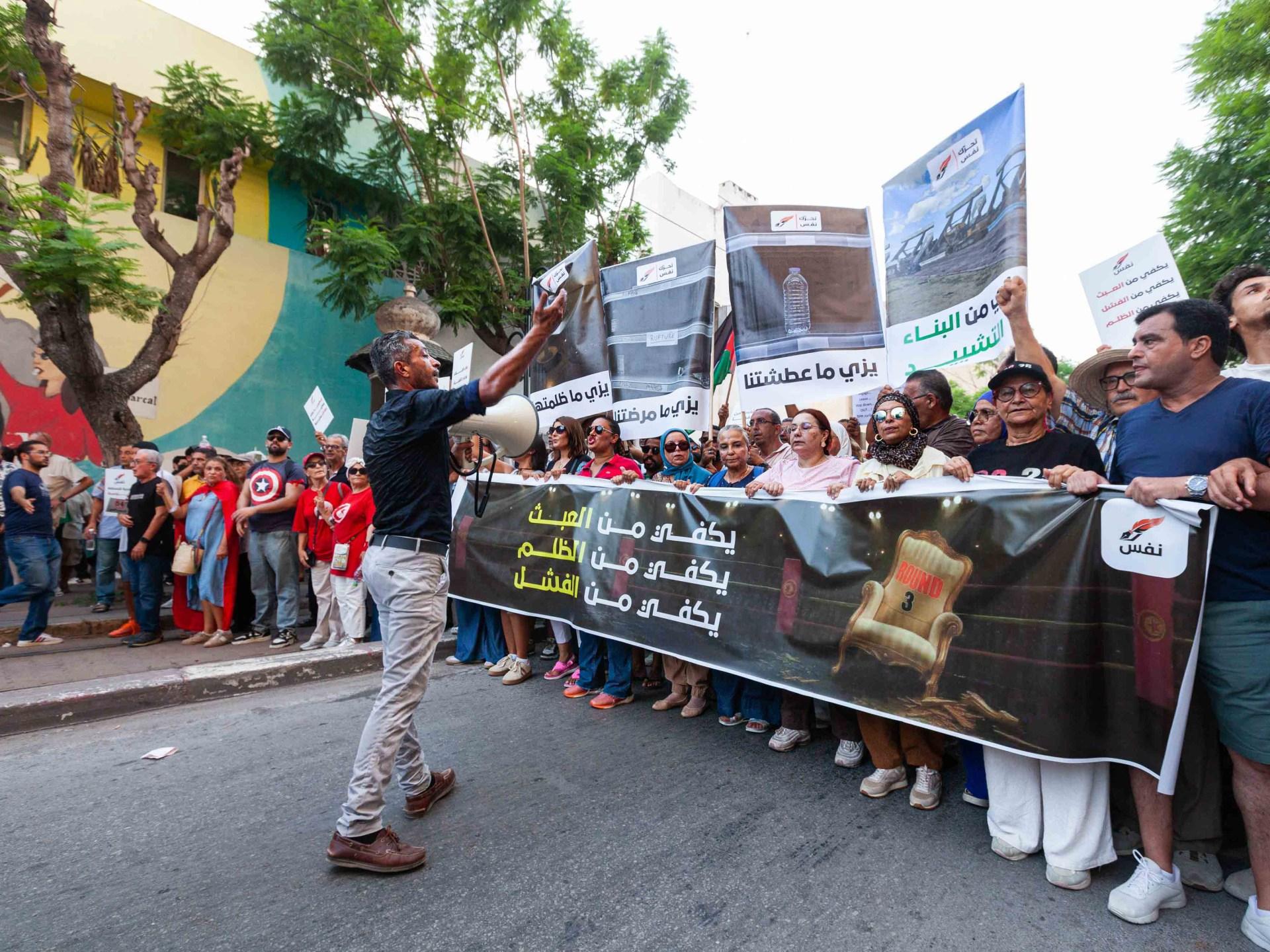
Al-Ghiloufi warned that the current regime does not allow for dialogue and considers itself the sole guardian of the people's future, viewing official economic data as inaccurate under a closed system lacking initiative. Statistics released by the Tunisian Forum for Economic and Social Rights show that Tunisia witnessed the highest number of protests in 2026 during the past decade.
Analysis & context
Analysis & Context
From an analytical perspective, experts indicate that this strike is not an isolated event but a manifestation of a deeper macroeconomic crisis characterized by rising inflation, eroded purchasing power, and the state's inability to secure external financing. Khلود Tomy, a Tunisian economist, stated that the current situation results from intertwined internal and external pressures, where global energy price fluctuations directly impact import bills and the country's need for foreign currency.
In the broader context, this economic downturn reignites the debate over structural reforms advocated by international financial institutions, which Khلود Tomy described as a "prescription" that the government has yet to implement. A significant part of this crisis stems from ongoing labor conflicts and long-term ineffective management; political analyst Souhaib al-Mazriqi views the current strike as a direct result of the conflict between workers' unions and employers' unions over agreements signed in 2019.
Some observers point out that the current government bears full responsibility for this collapse in public services due to its monopoly on power and lack of transparency, according to Ahmed al-Ghiloufi. The analyst confirms that the current situation represents the tip of the iceberg of a comprehensive crisis, as the country lives under a closed system that does not allow dialogue and considers itself solely entrusted with the people's future without accepting any real partnership.