Sourced fact
The News
Fighting intensified sharply in Ethiopia's Tigray region on September 23, as Tigrayan forces gained control over three local airports and the conflict spread to neighboring areas of Afar and Amhara, threatening the peace agreement reached in Pretoria in 2022.
British journalist Martin Plout indicates that President Donald Trump's administration conducted a strategic calculation by lifting sanctions imposed on Eritrea to bolster its position against Iran's Houthi militia and ensure Red Sea security, viewing this move as granting new political weight to an oppressive regime in Africa.
A political analyst clarifies that the timing was not random; the escalation of violence occurred just days after Washington's decision to remove entities and Eritreans from the U.S. sanctions list, thereby reducing pressure on the Eritrean government, which has gained increasing strategic importance as security around the Red Sea deteriorates.
Reports indicate that new regional alliances are forming in the region; seven Ethiopian groups announced an alliance on September 21 aimed at removing Prime Minister Abiy Ahmed's government, while the Ethiopian government denied Eritrea's involvement in supporting armed groups despite suspicions to that effect.
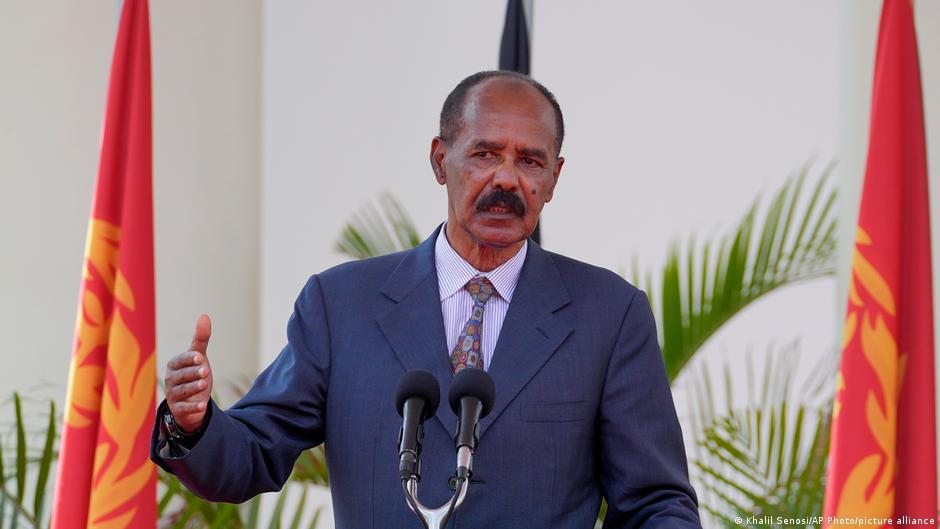
Experts warn that escalating conflict in Tigray could turn into a full-scale regional confrontation if Eritrea intervenes militarily again, especially given the deterioration of relations between Eritrean President Isaias Afwerki and Ethiopian Prime Minister Abiy Ahmed since the end of the previous war.
Researcher Moses Okello confirms that the geopolitical context has changed radically compared to the previous Tigray war, as the Red Sea has become a theater for global tensions linking Iran, Yemen, Saudi Arabia, and the UAE, making any Eritrean intervention a major risk that could transform the Ethiopian conflict into an international war.
The analysis also indicates that lifting sanctions may not make much difference on the ground given Eritrea's nature as an economically closed country that does not rely on foreign trade, but the political and geopolitical importance of this decision exceeds direct economic benefits.
Analysis & context
Analysis & Context
From an analytical perspective, analyst Abd al-Rahman Saeed sees the broader geopolitical context as the decisive factor here; a war is ongoing against Iran, and the Strait of Hormuz has been closed for a long time, granting Eritrea a new strategic position to strengthen its relations with the United States in the Bab el-Mandeb strait.
In the wider context, Eritrea controls long coastlines facing Yemen, and its Asab port lies south near one of the world's most important maritime shipping lanes, making cooperation with Washington or even non-enmity toward it a matter of great strategic value amidst radical changes in the region.
However, this deal carries significant risks; Eritrea is considered one of the most authoritarian countries in the world and has not held national elections since its 1993 independence. It also deployed troops alongside Ethiopian federal forces during the previous war, raising questions about the nature of potential intervention.
Finally, experts warn that any new confrontation between Ethiopia and Eritrea will not occur in isolation from the region; regional alliances are clashing dangerously in the Horn of Africa and the Arabian Gulf, and local tendencies could transform into a comprehensive international conflict threatening the entire stability of the Red Sea.